
Fair Test: Acing Experiment-Based PSLE Science Questions II

 Many pupils get confused whenever they encounter experiment-based questions on conducting a fair test and ensuring a reliable experiment. These are important question types that a pupil must be able to differentiate in PSLE Science.
Reliability of experiment will be explained in the next article. In this article, I will give you two specific examples on what a fair test is about and how to tackle questions involving fair tests in PSLE Science.
How to conduct a fair test
- To conduct a fair test is to ensure that only the independent variable in an experiment can change while all other control variables remain the same.
- If more than one variable is changed, any change in results could be due to the variables that are changed and not because of the independent variable.
- Thus, the aim of an experiment could not be investigated anymore.
- Remember that it was mentioned in the previous article that in any experiment, only one variable can change.
Example
Hercules carried out an experiment to find out the strength of two different materials, X and Y. He used the materials to make two objects A and B as shown in the diagram below. He then placed identical metal plates on top of Object A and Object B as shown below until they broke.
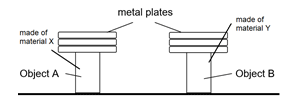
Which variables below must be kept constant in this experiment to ensure a fair test?
- Volume of each metal plate
- Material of each metal plate
- Same volume of Object A and B
- Material of Object A and B
Key Points to Note
- Aim of experiment
To find out the strength of two different materials, X and Y. - Independent variable (Only variable to change)
Material of Object A and B - Dependent variable (measured variable)
Number of metal plates placed on top of Object A and B before they broke. - Control variables (All other variables in the experiment to keep the same)
Volume and material of each metal plate, same volume of Object A and B - Only independent variable can be different
Only the independent variable, material of Object A and B, can be different while all other variables are kept the same to ensure a fair test. Any change in result is thus due to the materials of A and B only and the aim of the experiment can be investigated and achieved.
About the Author