
How to Score for Explanatory Questions in PSLE Science

The biggest problem faced by pupils in PSLE Science is not knowing how to phrase their answers properly or completely for open-ended questions in Booklet B.
Many of them think that their answers are correct which turn up to be wrong. Sometimes, they do not get any mark at all for a question even after writing one whole paragraph to explain.

This is especially true nowadays as half-mark is no longer being awarded for PSLE Science Booklet B. A pupil gets either 1 mark or zero for a 1-mark question. For a 2-mark question, a pupil can still get 1 mark if he/she manages to explain one complete point correctly.
How can pupils explain the questions correctly and thoroughly so that they will get the full marks that they deserve?
The following criteria are very important when it comes to explaining a question correctly and thoroughly:
- Understanding of concepts learnt in each topic
- Having the main idea/overall picture of each topic/theme (For example, in the topic of adaptation, the main idea is about survival. Eventually, the question testing on adaptation must be linked to survival or how specific adaptation links to survival)
- Able to apply keywords/concepts/process skills learnt in specific scenario given
- Able to pick out contextual clues given in the question
- Having answering techniques especially in explanation type of questions
I have shared with you some Useful Techniques to Tackle PSLE Science earlier. Today, I am going to share with you an answering technique using "Begin and End". This technique can be applied on explanation-type questions which usually end with phrases like – "Explain why", "Explain how", "Give a reason", etc.
Most of the questions in PSLE Booklet B require a pupil to explain. Thus, if one is able to explain correctly and thoroughly, he/she is more likely to do well for Booklet B.
It is important not to skip steps in explanation. Explain in steps from Begin …to ….End. Explain how one event leads to the other event till the end point is reached. From A → B → C…→ Z.
Example
Ques: Why is it that a plant will die when placed in a cupboard?
Ans: When placed in a cupboard, the plant cannot make food and will die. (incomplete)
What is missing? (Begin)When placed in cupboard -> no light -> cannot make food -> (End) die (Not thoroughly explained how an event leads to another event till end point is reached. This could be an example of zero mark.)
"Begin and End" Answering Technique for Explanatory Questions
Begin
State what is given or observation.
Concept/Contextual clues
Bring in a scientific concept/keyword to support what you have stated. Bring in contextual clues.
Expand
Elaborate on the concept brought in. Support the concept with data given in tables/reasons/by comparing.
End
Link back to the end result of question.

Let's study 2 examples to familiarise with the Begin-End Answering Technique.
Begin-End Technique Example
Lynn carried out an experiment as shown below. She filled up a flask with coloured water and covered the opening using a stopper which has a tube in it.
She placed the flask into a basin of hot water at 90°C. After a while, she noticed that the coloured water rose up the tube.
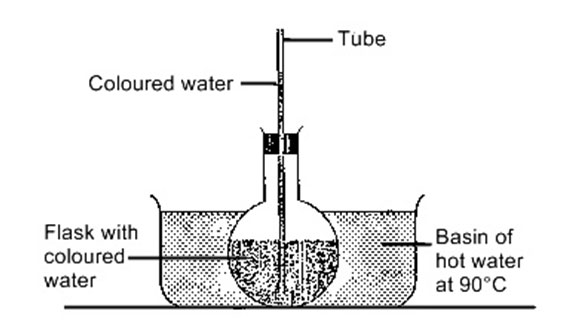
Explain why the coloured water rose up the tube when the flask was placed in the hot water?
Begin
Placed flask in hot water.
Concept/Contextual clue
Contextual clue - basin of hot water at a higher temperature of 90°
Heat transfer
Expand
Coloured water gained heat from hot water in basin and expanded.
End
Coloured water level in tube rose up.
Complete Answer in Sequence of Events
When the flask was placed in the basin of hot water, the coloured water gained heat from the hot water in basin and expanded in volume. Thus, the coloured water in the tube rose up.
Conclusion
As you can see from the two examples above, try using the Begin-End Answering Technique whenever you encounter questions that require you to explain how or why. This structured way of answering will help you to brainstorm and organise your points so as to score more marks in PSLE Science Booklet B.
About the Author